

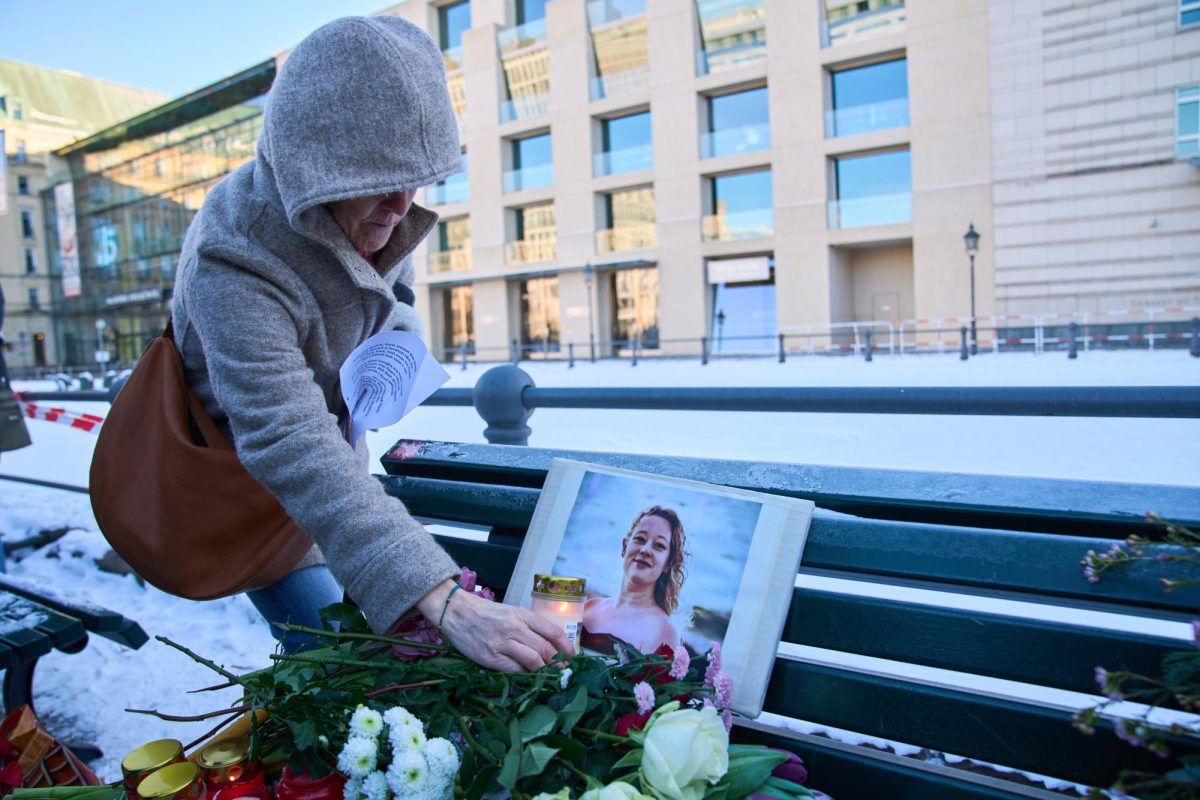
Last Wednesday, Jonathan Ross, an Immigration and Customs Enforcement (ICE) agent, fatally shot U.S. citizen Renee Nicole Macklin Good in Minneapolis. This shooting, which resulted in the death of a wife, mother and teacher, comes after a drastic increase in ICE presence as a result of President Donald Trump’s crackdown on immigration. We believe these violent tactics by ICE reveal the inhumanity of their processes and existence as a tool for Trump’s increasingly authoritarian government.
Even predating the killing of Good, concerns have been raised across the country over masked, armed officers walking the streets of American cities. The raids and forceful approach of officers have transformed streets in Minneapolis, Chicago, Los Angeles and others into sources of fear for many.
As Good’s wife, Rebecca Good, stated after the shooting, “We had whistles. They had guns.” This statement highlights the power imbalance between ICE agents and civilians. The unnecessary force by which agents are carrying out orders from the Department of Homeland Security is a clear sign of the agency’s position above the law.
Regardless of how tense the confrontation between Ross and Good was, we believe high-stress environments such as this should be handled with far more tact by law enforcement. In cases such as this, de-escalation is the most obvious and least deadly choice. ICE agents need to be held to a higher standard of safety and legality than they currently are. As it is currently utilized, violence only serves to further escalate these situations.
This incident is just a glimpse into the larger issue at hand. We are seeing a clear increase in violence and the use of excessive force by ICE officers. Under the U.S. Department of Justice Manual, the use of deadly force by law enforcement should always be a last resort, only used in situations where an individual poses a danger to law enforcement or other people.
The ICE agent who shot Good, as well as recurring attacks on citizens and non-citizens alike, demonstrate ICE’s blatant disregard for U.S. laws. It is evident from various video angles of the incident, as well as Good’s last words, “That’s fine, dude, I’m not mad at you,” that there was no violent escalation that required Ross’ fatal response. Additionally, Good’s car slamming into a telephone pole after she was shot shows the lack of foresight from Ross, as her car could have easily been driven into a crowd of people instead, harming far more than just herself or Ross.
Despite this, government officials and media sources are labelling the shooting as an act of self-defense on behalf of Ross. Homeland Security Secretary Kristi Noem has since called Good a “domestic terrorist” who used her vehicle as a weapon against ICE agents on the scene. Fox News host Jesse Watters emphasized the presence of “pronouns in her (Instagram) bio,” her “lesbian lover” and children from a previous marriage, clearly as an attempt to label her with polarizing political traits rather than recognize her as a woman leaving behind a grieving family.
Good had no criminal record beyond a traffic ticket, with her death taking place minutes after she dropped her youngest son off at school. Community members characterize Good as a “compassionate neighbor” who was trying to legally support the immigrant community through peaceful protest.
The footage showing Ross’ perspective of the shooting captured an agent calling Good a “f*cking bitch” after she was fatally wounded. Not only is this a clear demonstration of the violence against Good being carried out in anger rather than in fear, but it also exemplifies the disconnect between what government officials are labeling her and the story of her life portrayed by loved ones. These cruel labels are brutalizing; they showcase the dehumanization prevalent in the minds of ICE agents as they survey city sidewalks and separate parents from their children.
Only a day after this devastating incident, two individuals in Portland were shot by Border Patrol, resulting in their hospitalization. The incident occurred following an assertion that the two people were linked to the alleged Venezuelan gang Tren de Aragua, though many question the validity of these claims. During the traffic stop, authorities stated “the driver weaponized his vehicle and attempted to run over the law enforcement agents.”
This echoes the response to Good’s death and, in our opinion, reveals a pattern of violent and increasingly dangerous attempts to detain individuals through immigration enforcement. ICE agents do not have the training, skillset or experience to wield as much power as the Trump administration is giving them.
Outrage has not only been evident within online discourse, but also at an NBA game in Minnesota when a fan screamed “go home ICE” during a moment of silence for Good. As the fan shouted, other spectators appeared to applaud, a reaction that mirrors growing discontent over the public’s increasing willingness to challenge ICE and demand accountability.
As the aftermath of Good’s death continues to unfold, we are seeing two extremes. Citizens are being brutally killed on camera for standing up for their marginalized neighbors, and the government is defending the actions of violence before any investigation occurs. This goes against First Amendment rights to freedom of speech and assembly, as well as the Fifth Amendment right to due process rather than public and unjustified execution.
Good’s death is exemplary of what all Americans should be aware of: no one is safe from the state-sanctioned violence of ICE, regardless of citizenship status.