

Grand Valley State University recently celebrated its fifth annual Sex Ed Week.
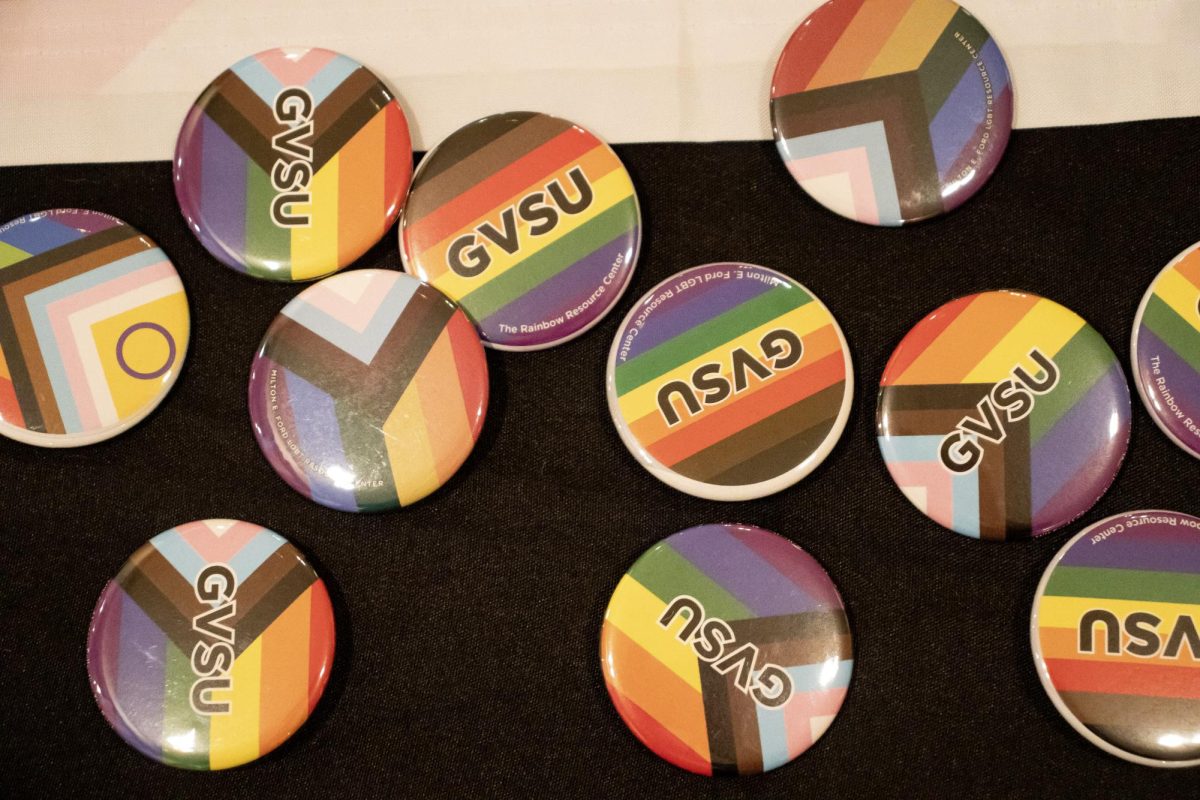
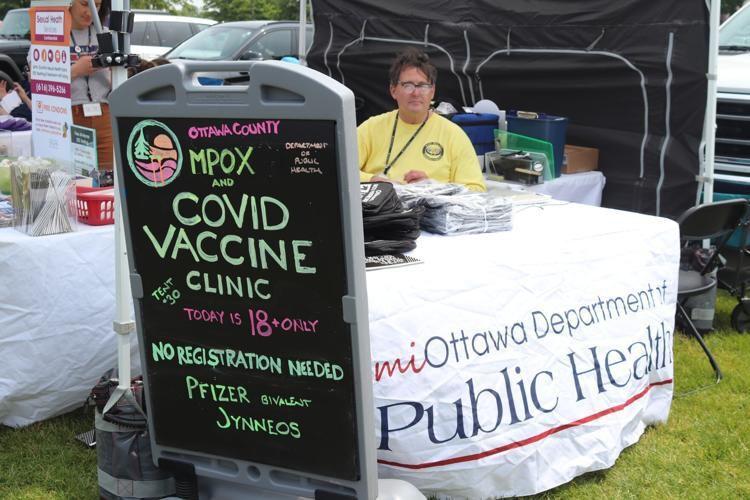
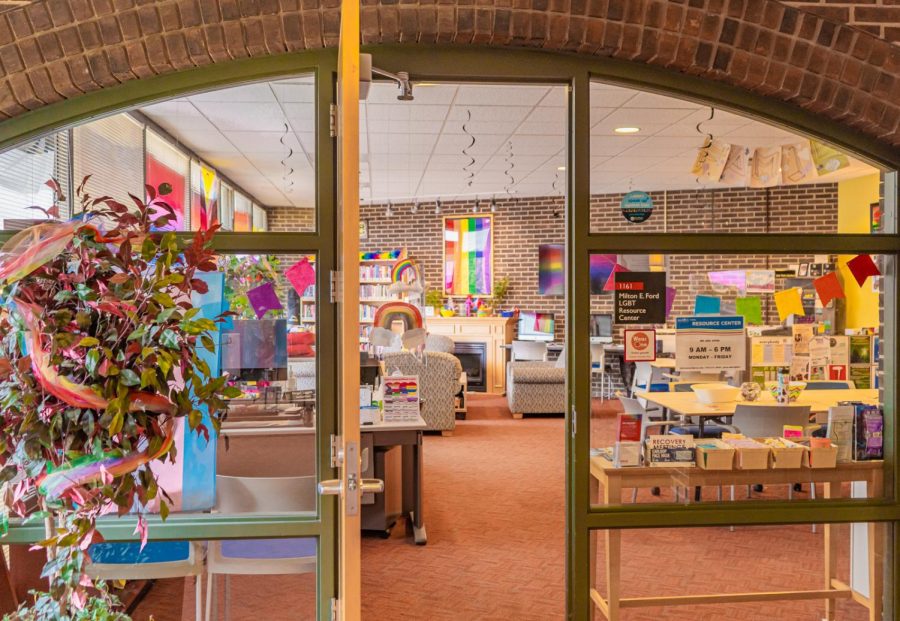
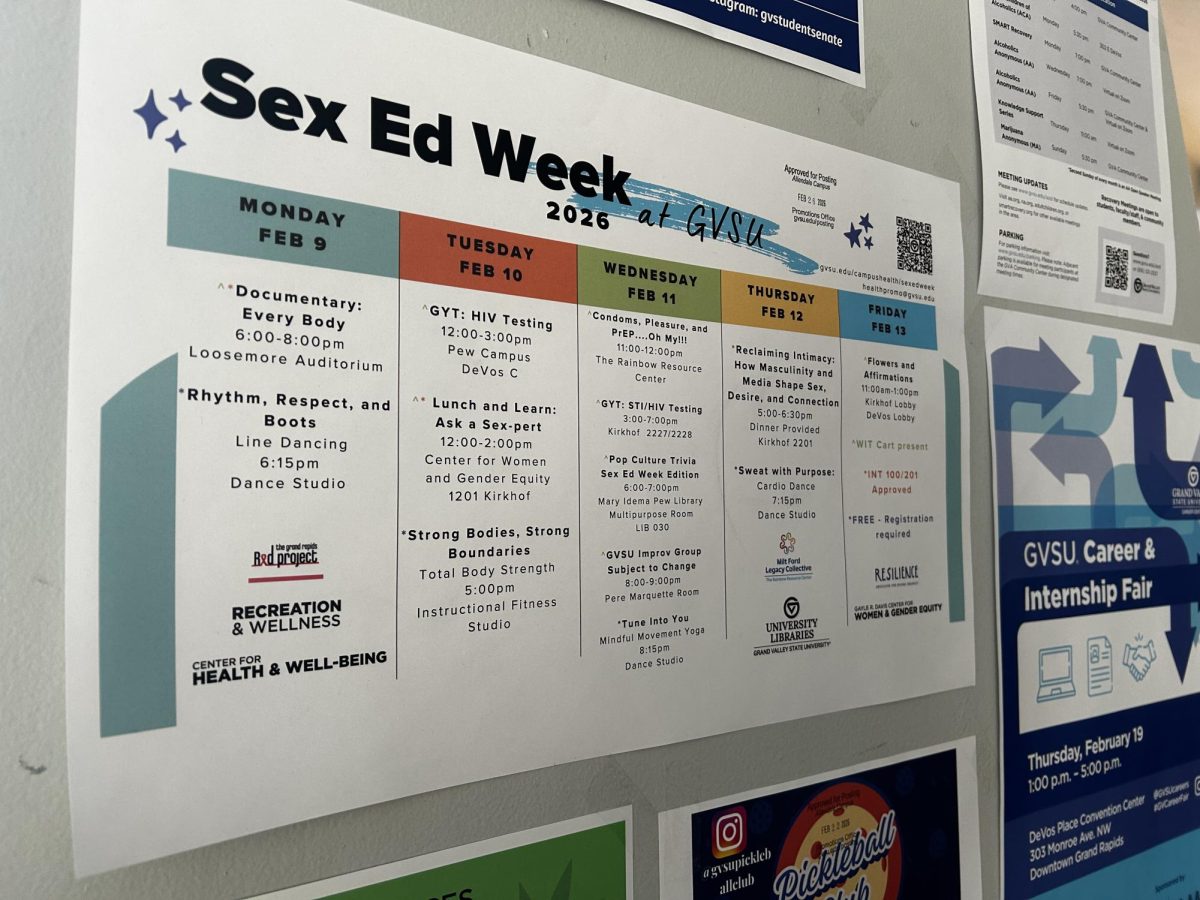
The Center for Health and Well-being collaborated with both on and off-campus partners, including the Rainbow Resource Center, Recreation & Wellness and the Ottawa County Department of Public Health. Last week’s activities were held at both the Valley and City campuses, including a documentary screening, Q&A and free sexually transmitted infection testing.
To kick off Sex Ed Week last Monday, there was a viewing of “Every Body,” a documentary about the intersex community and the non-consensual surgeries many intersex individuals are forced to endure in childhood. The documentary was shown at the Loosemore Auditorium. There was also a group workout session at the Instructional Fitness Studio. The goal of the workout was to instruct individuals on how to properly use exercise equipment, and to create an environment that encouraged body positivity.
On Tuesday, there was free HIV testing at the City Campus. The testing was provided by The Grand Rapids Red Project, which offers a variety of HIV prevention and treatment services, including free testing. There was also a Q&A titled “Ask a Sex-Pert” hosted by the Center for Women and Gender Equity.
University Health Promotion Specialist Heather Alberda was the main speaker at the event, and answered students’ questions regarding sexual health. When asked about the importance of Sex Ed Week, Alberda explained that conversations about sexual health don’t always occur naturally in day-to-day life.
She emphasized the importance of workshops and peer discussions, which can help normalize conversations about contraceptive use and STI testing. Alberda additionally pointed out the importance of Sex Ed Week in that it highlights inclusivity, showcasing perspectives from different cultures and identities.
“Sex Ed Week is important at GVSU because it gives students real, relevant information that actually applies to their lives right now,” Alberda said. “In college, a lot of students are navigating relationships, consent, sexual health and identity on their own for the first time. Having a dedicated week focused on these topics helps fill in gaps, and makes it easier to make informed decisions.”
On Wednesday, the Rainbow Resource Center held an event titled “Pleasure, Condoms and PrEP…Oh My!” The event focused on teaching students about safe sex practices, contraceptive use and ways to increase sexual pleasure. Additionally, the event educated students on pre-exposure prophylaxis, or PrEP, which is a medication used to reduce the risk of getting HIV during sexual intercourse.
Rainbow Resource Center Assistant Joey Grubbs-Hulst explained how inclusivity is necessary for sex education.
“For many LGBTQIA+ folks, the sex education we received was not inclusive of our experiences and did not provide us with the information we needed,” Grubbs-Hulst said. “Sex ed also often excludes asexual and aromantic people entirely. For sex ed to be holistically educational, it must be inclusive.”
On Thursday, there was a workshop titled “Reclaiming Intimacy: How Masculinity and Media Shape Sex, Desire and Connection.” The workshop focused on how porn, hookup culture and video games have affected male students’ relationships with intimacy. Part of the discussion focused on how loneliness and emotional suppression can lead to hyper-sexual tendencies, especially among young men. The workshop proposed four core aspects of healthy manhood, including connection, authenticity, vulnerability and empathy.
Other events held throughout the week included a sex trivia night, an improv show and free STI testing provided by the Ottawa County Department of Public Health. Sex Ed Week concluded with a giveaway on both the City and Valley Campuses, in which flowers and affirmation cards were handed out to students.
“Overall, every event played a role in making Sex Ed Week informative, inclusive and approachable,” Alberda said. “That collective impact is what I’m most proud of.”