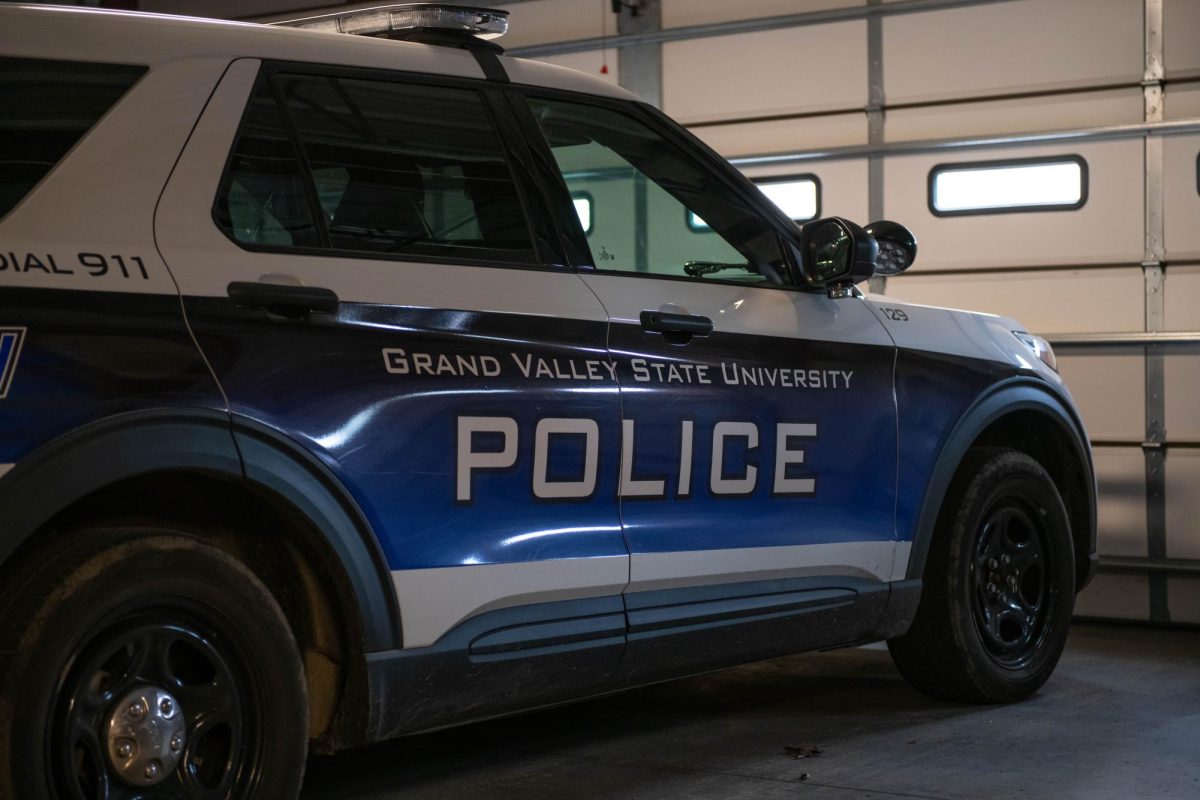


A Grand Valley State University student and her professor spoke with the Lanthorn to shed light on accessibility issues on campus during recent winter storms.
Student Melissa Eger has a medical condition that causes her limbs to go inward, which requires braces and canes to walk and a mobility scooter to traverse campus. On Monday, Feb. 2, Eger was sitting in the Kirkhof Center waiting to go to her speech class in another building. However, snow was blocking Kirkhof’s entryways, preventing her from leaving.
The Americans with Disabilities Act (ADA) requires public agencies to maintain snow removal on walkways, but Eger said she couldn’t leave the building.
“There was snow blocking the doors from the sidewalk,” Eger said. “I knew I would not be able to leave the Kirkhof Center until it was removed.”
Eger emailed her professor, Carl Brown, to let him know about the situation. The University itself hadn’t shifted to remote status, but Brown gave her and others the option to join virtually.
“It was a day where there was a complete lack of mobility for those that are in Melissa’s position,” Brown said.
Brown said sidewalks are usually cleared and he appreciates the work that goes into that snow removal, but remains confused as to why the University held classes in the first place that day. Feb. 2 never moved to remote status but earlier in the same storm, there had been multiple remote days. Brown believes the conditions Feb. 2 were worse than the days that did go remote.
“While I have no issue making any and all accommodations required to make my teaching accessible, I should not have to make the call in situations like this one,” Brown said. “If sidewalks are impassable, which they were from the day before, GVSU should move to remote status.”
It deeply bothered Eger too. She makes a point of attending class and the situation put her in a position where she felt like she was the reason class had to be altered.
“I was stressed out,” Eger said. “I really do enjoy the class. I’m definitely an attendance person. If I don’t make it to class, then I have a lot of anxiety.”
Eger did look into the various options offered by Student Accessibility Resources, which includes shuttle services for students with mobility issues, but none of the times matched up with her class’ meeting time. After the class, Brown reached out to SAR, but felt it was a fruitless effort.
Brown was referred to Facility Services Vice President Rence Meredith, who cited the van service.
“(Meredith) essentially said that because the aforementioned van service was available, they were not required to clear the sidewalks,” Brown said. “He said it in a way which made it seem like the existence of this service superseded ADA laws.”
University Communications Assistant Vice President Chris Knape provided a statement on behalf of Meredith.
“We are sorry this student had this experience,” Knape said. “Our Facility Services team makes every effort to keep sidewalks clear and safe, including working around the clock to keep up with winter weather conditions caused by wind and snow.”
The statement also referred to the van service.
“The SAR reached out to the student and her professor to remind them of the availability of this service after the event,” Knape said.
Eger says similar accessibility issues have occurred before, and said she knows other students who have been in her position. She spoke about a prior occasion where she elected to use the van service while the pedestrian walkways were obstructed by snow and ice.
“For one of my classes in Mackinac Hall, the van service took me to the B-Wing,” Eger said. “The B-Wing was covered in snow and I ended up having to push my scooter through the snow just to get inside.”
This situation prompted Eger to have less faith in the van service. However, it also put her in a difficult position regarding attending class if the sidewalks were not cleared.
“SAR has not given me any relief,” Eger said. “(They) gave me phone numbers (of) the grounds people, but they are not going to come help me right away if I am stuck. That is not going to be useful to me.”
Brown agreed with Eger’s point, saying the van service is useful but the snow still wasn’t handled properly.
“We are creating an emergency situation by not handling this weather appropriately,” Brown said. “That’s the real danger here.”
Being situations like Feb. 2 have affected Eger and other students, Brown expressed little faith that the issue will change.
“I was hoping for some real solution from SAR,” Brown said. “It really ended up being more like kicking the can down the road.”
Brown noted that weeks later, there still has been no resolution to this issue. Eger maintains the importance of speaking up for students with disabilities.
“This impacts not just me, but the whole community with disabilities as a whole,” Eger said. “Even if I can get out of a snowy situation and have people help me, the school should implement something rather than just talking about changing.”
Brown said that whether willful or not, there is a clear form of inequality taking place on campus when the sidewalks aren’t cleared properly. He closed by encouraging those without disabilities to consider the experiences others go through.
“People are being discriminated against based on their ability to move freely about campus because they have a mobility situation,” Brown said. “We take so many things for granted as mobile folks (when) other folks are dealing with things that we don’t even think about. I think we should highlight that as a human issue in addition to a policy issue.”