

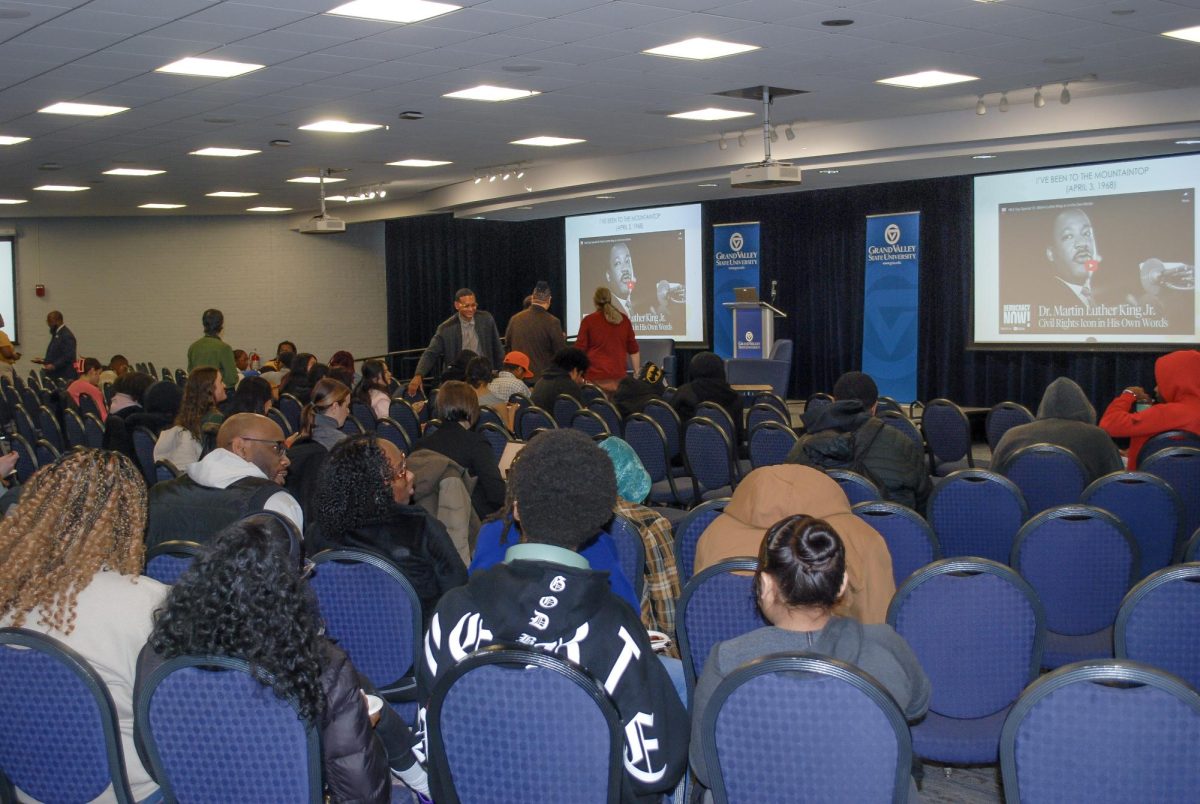
Last Wednesday, Grand Valley State University hosted Derrick Johnson, president and CEO of the National Association for the Advancement of Colored People (NAACP), for a Martin Luther King Jr. commemoration.
Johnson was originally supposed to speak in January, but the event was postponed due to inclement weather. His address, “Mission Possible II: Building Community, Uniting a Nation: the Nonviolent Way,” reflected on the life and legacy of King and the work that still needs to be done to achieve his goal of a “beloved community.” King’s ideal of a “beloved community” is a society in which justice, peace and love prevail and every individual is recognized as a valuable member.
Originally from Detroit, Johnson attended Tougaloo College in Mississippi, where he helped found the school’s first NAACP chapter after he realized that the historical events he read about were not so far in the past after all. He found himself in a room with figures that he thought had been deceased, fighting the same laws decades later.
During the event, students listened to King’s final speech, “I’ve Been to the Mountaintop.” They were then given time to discuss their reactions and shared the changes they would like to see on campus and in society, along with how they plan to invest in their community to become a part of the solution.
Senior Maisha Marriott spoke about the need for honest education and intentional collaboration. Growing up in Jamaica, Marriott feels she received a less sanitized version of history, and is expected to soften truths when speaking about difficult topics.
“We need to let people cry, be uncomfortable and grapple with the real content,” Marriott said.
Johnson emphasized the power and agency that individuals have. Not every action is going to change the world, but it’s important to have a clear goal for collective achievements.
“A unique thing about Dr. King is, he was a passive observer until he wasn’t,” said Johnson. “You’re ordinary individuals, but you have the capacity to do some extraordinary things if you move from the space of a passive observer and place yourself in the center of real conversation.”
Johnson pointed out that although King is often recognized as the leader of the Civil Rights Movement, he came onto the scene of a movement that had already been taking place for years.
“We should never deify human beings, but recognize their contribution, and also recognize that each one of us has the potential inside of us,” said Johnson.
Johnson reiterated the idea that uniformity is a myth and that uniqueness is genius. Rather than forcing everyone to conform to the same standards, unity should be achieved by embracing unique identities and making room for everyone to embrace theirs.
“If I show up in the full identity of who I am, and I accept you for who you are, and we meet in places where we agree and respect each other and challenge each other where we disagree, that’s unity,” said Johnson.
Johnson went on to state the current political climate utilizes race and immigration status to distract and weaken social unity. He ended his address by encouraging students to build their critical thinking skills by continuing to place themselves in rooms where important conversations are taking place, and that naturally, they will find their role in contributing to the solution.
“Our strength as a nation has always been diversity, and when you look at our greatest moments, it’s when many communities were called upon to contribute,” said Johnson.