

Recently, millions of people across the country took part in the “No Kings” demonstrations against the Trump administration.
The March 28 demonstrations were part of the third No Kings Day since President Donald Trump took office last January. The latest wave of demonstrations followed a series of defining moments in Trump’s second term, including the killings of Renee Good and Alex Pretti, and the U.S. government’s escalating war with Iran.
Across the country, and even in parts of Europe, people took to the streets calling for various administrative responses, from policy changes to impeachment, and even radical change in the system itself. As is often the case when national movements gain momentum, residents of Grand Rapids were quick to join in.
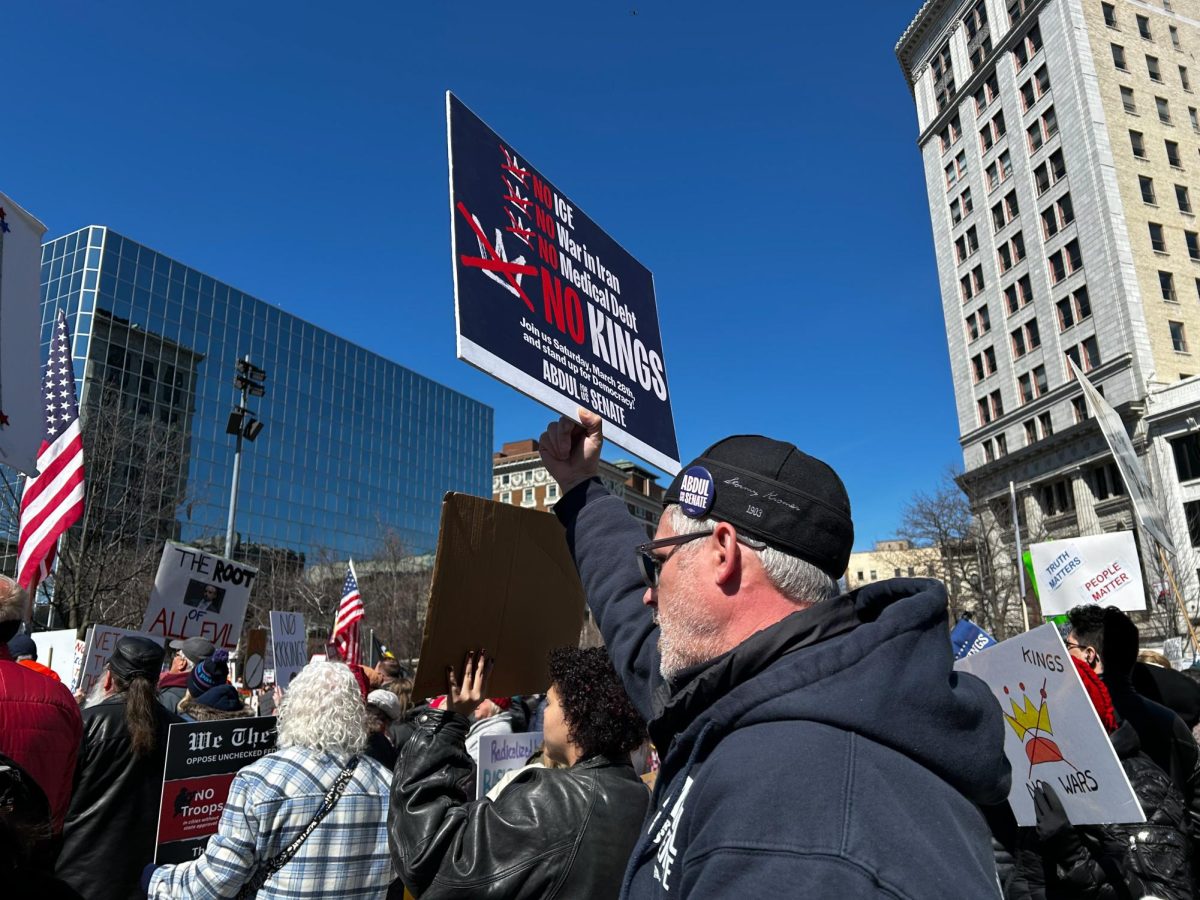
Activists, organizers and fed-up constituents from across the city’s three wards and beyond gathered at Rosa Parks Circle to take part in the demonstration. Several prominent local activists spoke on several issues, and the event ultimately culminated in a march to close out the day. I was among those in the crowd, which gives me a firsthand perspective on the “No Kings” demonstrations and what they meant to participants on the ground.
To begin, I should acknowledge my own cynicism. Throughout this article, I refer to the event as a “demonstration,” not a “protest,” and that choice is deliberate. I can’t genuinely call it a protest. This event, like others held that day, felt about as state-sanctioned as they come. Indivisible, the group behind these demonstrations, routinely secures permits, coordinates with city officials and ensures a police presence.
While the event carried the outward appearance of a protest, I struggled to see it that way. In my view, once you’re working in coordination with the state, it stops being a protest and becomes something else entirely. Even if you believe that cooperating with city governments is different from cooperating with the federal government — a distinction I do not accept — this “protest” still worked alongside the same city government that has overseen multiple police killings of Black residents in just the past four years, including the recent killing of Da’Quain Johnson.
To me, protests are meant to directly challenge the state. It’s hard to argue, with any seriousness, that the “No Kings” demonstrations met that standard. There were a few exceptions in places like Los Angeles, where demonstrators stayed beyond their permits and confronted police attempting to disperse them, and for that, they deserve credit.
That’s not to say the Grand Rapids Police Department wasn’t heavy-handed in its presence. While the march was underway, I watched masked, GRPD bike officers, dressed head to toe in black, assemble in the shadows. I also saw a police truck carrying officers equipped with tear-gas launchers and other crowd-control gear, staged and ready if things escalated.
It was unmistakably an attempt at intimidation, but it didn’t feel like a response to anything the crowd was actually doing. There wasn’t a clear provocation, no visible shift that would justify that level of readiness. If anything, it felt routine, less a reaction to this particular demonstration and more like GRPD falling back on its usual playbook.
Now, having said all of that, I still believe this was a worthwhile event for a few key reasons. This administration has become a politicizing force for many Americans. People who otherwise wouldn’t think to get involved in politics now feel it is their moral obligation to resist this administration. Across the country, millions have been driven into the streets by rising costs of living, cuts to social programs and anger over immigration enforcement and foreign policy.
People are angry. They’re frustrated with economic pressure, endless foreign entanglements and attacks on their friends, neighbors and communities, especially those who are trans or otherwise marginalized. They’re disturbed by seeing people in their communities detained and taken away by masked ICE agents.
While these demonstrations may fall short as a direct challenge to state power, they are still an important first political action for many newly politicized people looking to fight back. I saw that firsthand in Grand Rapids. There were people in that crowd I had never seen at previous protests, and that stood out.
Most notably, I saw people holding protest signs that were clearly painted over Trump campaign signs. To me, that suggests something deeper is shifting. People who once supported Trump are beginning to turn, and for some of them, No Kings is where that process begins.
These demonstrations did more than give people a space to vent for a day. They brought together a wide range of organizing groups, many of them rooted in socialist organization and direct action, all working toward more fundamental challenges to power. Some of these organizations and activists have already been doing that work in Grand Rapids, directly confronting what they see as state violence, whether that violence be from ICE or GRPD.
To summarize my thoughts: Many of us got out to the demonstrations, voiced our displeasure and made connections with organizations ready to fight. Now what?