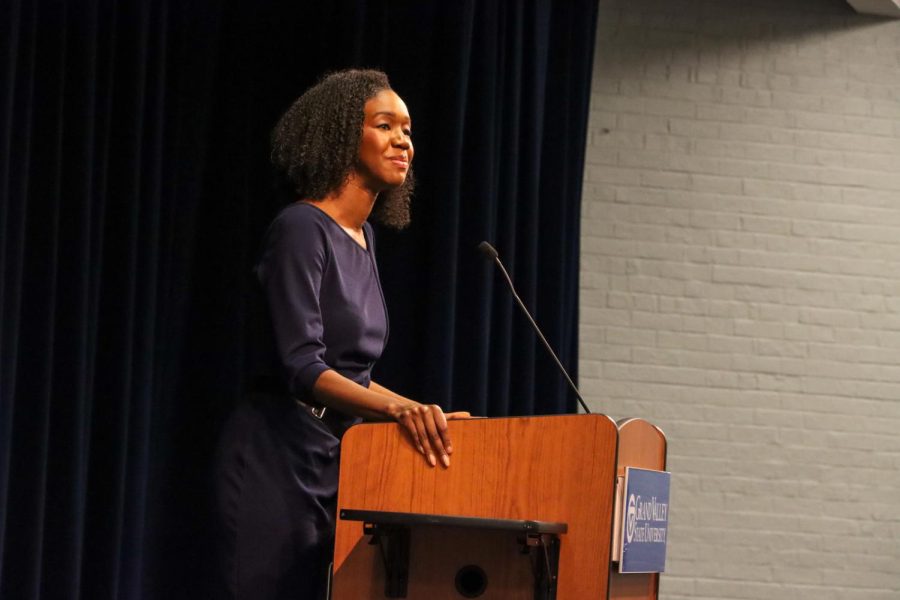



Last Wednesday, Grand Valley State University hosted nationally recognized scholar Dr. Dar Mayweather as keynote speaker for Martin Luther King Jr. Commemoration Week.
Mayweather, a two-time GVSU graduate and leadership studies faculty member at the University of North Carolina Wilmington, empowered students and professionals to articulate their strengths and lead with purpose. He challenged attendees to connect King’s vision with practical strategies for community impact.
The annual week of events, which typically include a silent march, discussions on nonviolence and service and volunteer opportunities, celebrates King’s legacy through a series of educational and community-focused activities. While some indoor events, including a stream of Mayweather’s speech, were held despite inclement weather, other gatherings were either canceled or postponed. The silent march originally planned for Wednesday was canceled, while keynote addresses by National Association for the Advancement of Colored People President and CEO Derrick Johnson and motivational speaker Damon Arnold were postponed. University leaders said the changes reflect ongoing efforts to prioritize safety while continuing to provide opportunities for reflection and engagement.
University President Philomena Mantella kicked off the keynote event by reflecting on King’s enduring legacy and relevance to education today.
“Nonviolence is an intentional practice, a commitment to understanding one anotherand working together diligently, even when it feels complex,” Mantella said.
She also emphasized GVSU’s cultivation of values that help students lead with confidence and agency.
“At GVSU, we view education as a holistic endeavor,” Mantella said. “Our work extends beyond academic achievement to include personal development, ethical leadership and a strong sense of responsibility to the communities we serve.”
As the current chapter president of Alpha Phi Alpha fraternity, junior Christopher Weaver introduced Mayweather and highlighted the speaker’s academic and professional history, Weaver noted that Mayweather’s personal journey fuels his commitment to students and professionals. Particularly, those from underrepresented communities, who praised him for pushing beyond personal and systemic boundaries to earn multiple degrees and build a career centered on leadership development.
Mayweather opened the talk by acknowledging its unusual format. Severe weather disrupted many of the in-person MLK celebrations throughout the week, prompting organizers to move portions of the program online.
“We are getting together to gain information about Dr. King, even when the weather keeps trying to stop us,” Mayweather said.
As he displayed images of King’s arrests, Mayweather referenced “The Radical King” by scholar Cornel West, a book which reframes King as a strategic, justice-oriented organizer who confronted systemic racism, economic inequality and militarism — not just as a symbolic dreamer. While King is often remembered as gentle and passive, Mayweather stressed that he was also disciplined, strategic and deeply committed to planning.
“We have access to King’s words — not just the books and the speeches,” Mayweather said. “It was the more radical King who was prepared and organized to take on political systems so that generations could experience change.”
Throughout his talk, Mayweather emphasized the importance of pairing inspiration with structure.
“It’s not just about conversations, and it’s not just about inspiration — it’s about delegation,” Mayweather said. “Vision gives us direction, but planning gets us there. King was gifted to do both.”
Mayweather added that leadership requires clarity of purpose.
“If you’re not clear on your impact, you may not be able to inspire generations,” Mayweather said. “When your passion meets planning, your courage meets clarity.”
Drawing on his own life, Mayweather shared how his vision for leadership did not begin with academic ambition. He spoke about growing up amid domestic violence and the murder of his brother, experiences that derailed his early education.
“I went from a 3.5 GPA to a 0.5,” Mayweather said. “I made it through high school, but barely. I didn’t have a vision to be a doctor. All that I’ve achieved came later.”
Mayweather then invited the audience to take out a pen and paper and place themselves on a scale between being more inspiration-oriented or more management-oriented, emphasizing the need for both approaches in response to social challenges.