

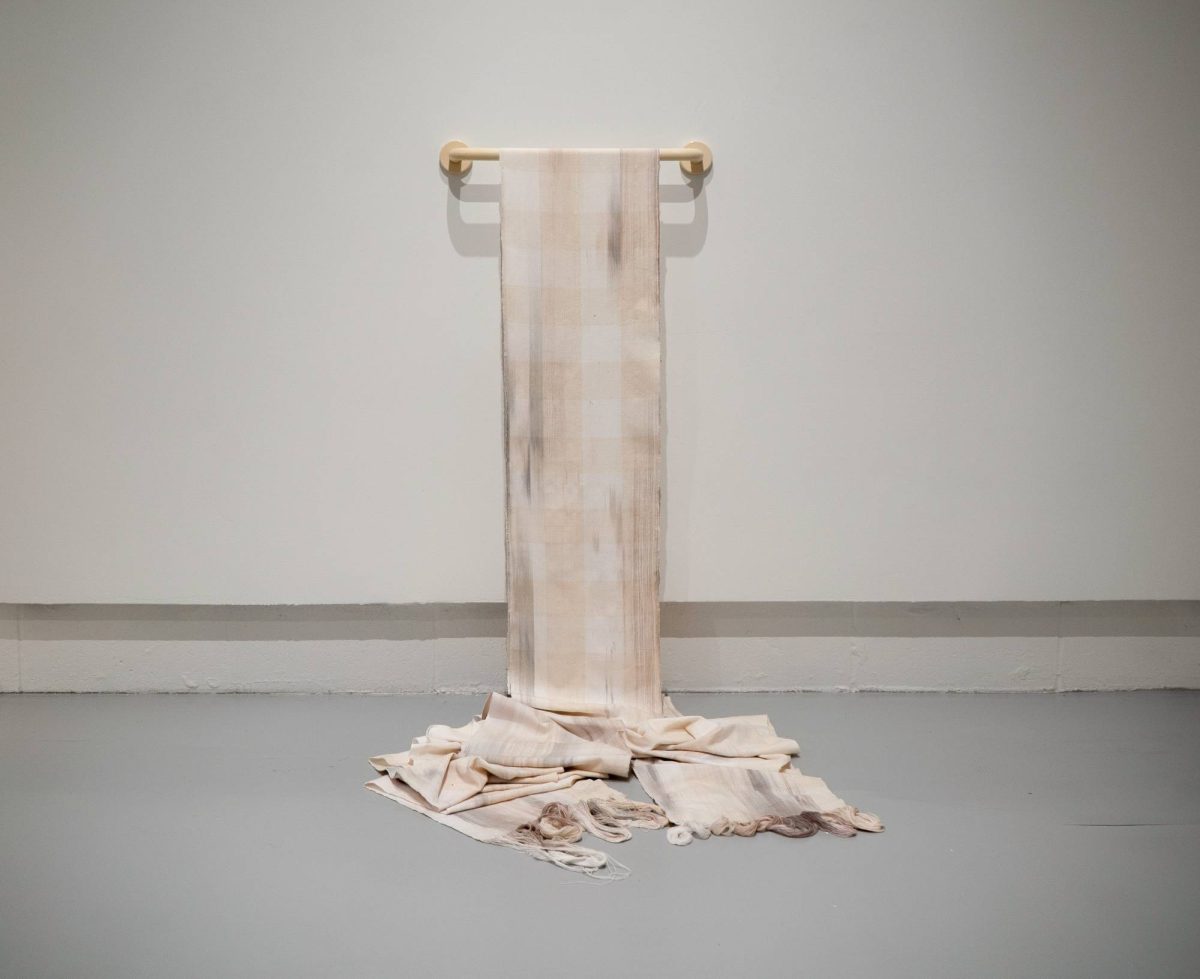
The Haas Center for Performing Arts Gallery is currently hosting “Between Rooms,” a group exhibition that explores domestic life, memory and identity through the work of four contemporary artists. Featuring Xiao Han, Maddie May, Sarah Sproule and Rachelle Wunderink, the exhibition looks at how people are shaped by the homes they grow up in and the roles they are expected to take on.
“Between Rooms” brings together works that use domestic materials, familiar imagery and everyday rituals to question what it means to raise others and to be raised yourself. Across the gallery, household objects become carriers of memory, conflict and care, showing how personal experiences are tied to larger social and political realities.
Han’s “Mahjong House” reflects on family connection and distance during the COVID-19 pandemic. Han, a first-generation Chinese Canadian artist, created the work in 2021 while pregnant and separated from her family in Wuhan. Mahjong, which plays a central role in the image, is an important game and social activity in her hometown.
“As someone born and raised in Wuhan, I saw how dramatically people’s social lives changed, especially around Mahjong,” Han said.
During lockdown, she felt deeply disconnected from her family, a feeling that became embedded in the work.
“Every time I look back at it, I’m reminded of how strongly I longed for connection with my family, and at the same time, how lucky I felt to be building my own,” Han said.
Han’s practice focuses on migration, language and early motherhood. She sees caregiving not as something that interrupts her work, but as something that shapes it. Her installation invites viewers into intimate spaces often kept private.
“I wanted the audience to feel as though they were stepping into a breastfeeding room,” Han said, describing the mix of vulnerability and strength that comes with early motherhood.
In contrast, Sproule’s “I must have answered in a dream” unsettles the idea of home as a safe or stable place. The sculptural installation features a phone, a table and figurines coated in pink latex paint, with plaster forms spilling across the furniture. The piece is the second version of a work Sproule first made in 2018 and later recreated in 2023.
Sproule said she was inspired by memories of watching her mother and grandmother sit by the phone for long periods of time. She was also interested in how bodies interact with domestic spaces.
“Gossip and phone calls were a big part of my domestic experience as a kid,” Sproule said. “I wanted to capture the idea of melting into the furniture we spend so much time around.”
The work also reflects Sproule’s experiences with religion and political division within families.
“The piece was ultimately about a communication breakdown and how difficult it can be to communicate with people with different beliefs,” Sproule said.
Wunderink’s “Pillow Talk no. 3” focuses on motherhood and the loss of identity that can come with it. The collage shows women’s bodies woven into pillows, using materials tied to domestic labor and traditional women’s craft.
“’Pillow Talk no. 3′ is part of a series of woven collages in which I weave only women into pillows,” Wunderink said.
The work reflects how women often rely on one another emotionally during early motherhood, while also being pushed deeper into domestic roles.
“All of the work in the show reflects the feeling of matrescence,” said Wunderink, who created the piece while caring for young children. “I often only had small snippets of time to create work.”
Since she began the series, the political context surrounding motherhood has shifted.
“The meaning has shifted beyond my personal experience,” Wunderink said, pointing to broader pressures placed on women to become mothers without enough support.
Together, the works in “Between Rooms” present the domestic space as both caring and complicated. By focusing on everyday objects and personal experiences, the exhibition asks viewers to reconsider the homes they come from and the roles they inherit.
The exhibition will remain open until March 27.