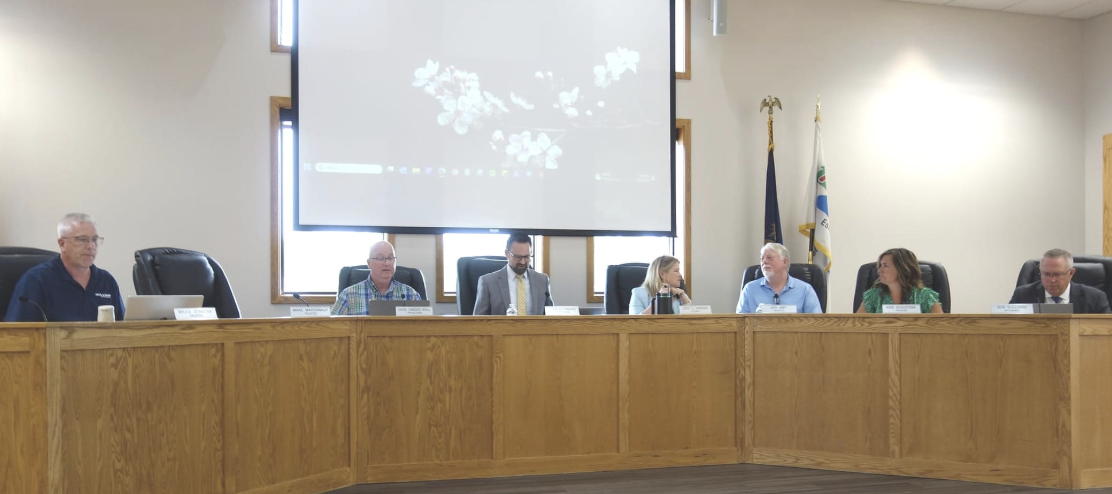



Last Thursday, two former U.S. ambassadors to NATO spoke at Grand Valley State University to address the future of the alliance.
The discussion was part of the Hauenstein Center for Presidential Studies’ annual Progressive/Conservative Summit, which aims to bring leaders together from varying political backgrounds for bipartisan discussion. Kay Bailey Hutchison, formerly a Texas senator, represented President Donald Trump during his first term, while Julianne Smith represented Joe Biden, having previously served as his deputy national security advisor. Hutchison and Smith talked extensively on their views concerning China and Russia.
Moderator and CEO Hank Meijer opened the talk by asking if the original alliance, as created 76 years ago, was still the cornerstone of U.S. foreign policy amid a shifting focus on China.
“I believe it is the cornerstone, but it’s because NATO is evolving,” Hutchison said. “The reason it is the longest-serving military-political alliance in the history of the world is because it has adapted to needs and changes.”
Hutchison served as ambassador during the onset of an ongoing trade war with China. China’s status as a global power has grown significantly over the decade through a series of economic initiatives. When she received the 2019 Missile Defense Review from the Department of Defense, which stated China was a potential adversary for the next decade, Hutchison said she and her European NATO colleagues were caught by surprise.
Hutchison emphasized NATO’s “economic alliances” with numerous, non-member partners, particularly the Indo-Pacific Four constituting Australia, Japan, New Zealand and South Korea. She later expressed that if it could be done, she would like to see a global economic alliance against China.
“We’re the umbrella of security for all of our countries, and that means we want the Asia-Pacific countries that are like-minded, and certainly have determined China is a potential adversary, (to come) together,” Hutchison said.
Smith noted that Hutchison was the first ambassador to push NATO to “care more about China,” and recognize cybersecurity and economic threats. During Smith’s tenure, China was written into NATO’s Strategic Concept. Smith cited this as an example of polarized administrations sharing a “common project.”
The ambassadors reflected on the admittance of the Baltic states to NATO in 2004 and questions of expansion overreach. Smith said a major concern at the time was whether more recently admitted countries would consume security or provide security within the alliance. Now, she says, member alliances in the region, particularly Poland, have been able to provide more financial support to Ukraine than the U.S., and have served as a route for munitions.
When Hutchison was a senator, she voted in support of building up defense against Russia. She believes Latvia, Lithuania and Estonia are still in place because NATO helped bolster their democracies and military defense.
“Putin is very careful not to attack a NATO country, so he goes to Georgia and Ukraine,” Hutchison said.
Smith was heavily involved in advocating for allied funding for Ukraine, and was in NATO when Vladimir Putin visited the alliance to demand it didn’t expand, which was refused. Under Smith, Sweden and Finland also joined the alliance.
“We fundamentally believe in a world in which nations get to choose the alliances they join,” Smith said. “Nations should have that option, that’s part of what exists in the UN Charter. All of those countries that knocked on the door of the alliance, they had the right to do that.”
A question arose during discussion over whether Ukraine could feasibly join NATO after the war, to which Smith said she thinks Ukraine could be a member of the alliance.
Hutchison agreed, stating Ukraine has “earned” NATO membership if the country would like to be involved in the alliance.
“I think they have been the most heroic people fighting Goliath,” Hutchison said. “We do owe them some support.”
A major topic raised was how or if the U.S. could maintain leadership and involvement in foreign affairs, among shifts in the global power dynamic. Trump has repeatedly expressed a desire to leave the alliance, although he is prohibited from doing so unilaterally.
“I would ask the question, ‘Who would you have lead the free world?’ to anyone who says America can’t be the leader,” said Hutchison. “America is the only country in the world that will assess a risk, and deter against it at any cost.”
Smith also acknowledged that through the elimination of USAID, China has filled in.
“If we don’t show up, if we don’t maintain these allied relationships, if we don’t lead in the NATO alliance, someone else will,” Smith added. “We have to ask ourselves how comfortable we’d be (if countries shifted towards China).”
Hutchison briefly addressed the Middle East at points, and expressed a desire for stronger partnerships with nations surrounding the Gaza Strip. She said a major “irritant” to security would be taken away if the U.S. didn’t have to worry about Iran’s role in the Middle East.
Hutchison added that a two-state solution in the Gaza Strip could be a pathway to other nations joining and establishing peace, which she sees an interesting advantage in.
“That (a two-state solution) would be a huge help for our defense initiatives because we’ve still got to look at Russia and China,” Hutchison said.
Looking toward the future of the war in Ukraine, Smith said she disagrees with Trump’s approach, but thinks he has realized Putin was “playing him” in Alaska. She sees recent sanctions on Russian oil as a major development, however, believes it’s hard to predict where Trump’s policies will land from week to week. She expressed support for sending Tomahawk missiles to Ukraine to “send a message,” which the Pentagon has since approved. Hutchison, agreeing with Smith’s points, also said Xi Jinping is likely monitoring the situation in Ukraine, and looking towards Taiwan.
Neither Hutchison or Smith addressed Trump’s controversial trade meeting with Xi the day prior.
Nearing the discussion’s end, Smith expressed concerns for the United States’ ability to exert “soft energy,” and negotiate with allies amid a massive shift in domestic political structure.
“There are concerns out there about what is happening inside of this country right now, and whether or not, without even realizing it, we’re shedding some of those strengths,” Smith said. “I hope that doesn’t become the trend, and we maintain that soft power, because when you combine American military power with soft power, nothing can beat it.”